Monday, July 20, 2009

7 Tour Of The Highlands

100 Miles
5000 Ft Climbing

7.5-8 hours saddle time

I'd like to report to you that I recently relocated myself, three bikes and little bit of money I have to Rochester, NY. Personal reasons. Now I was overcome emotionally with the move. Having found a climber's paradise in Cattaraugus, where I lived before for a year, this new area sort of first felt like having the urban feel to it, flat and fit for the street smarts. I wondered whether I would ever see valleys and mountains again.

I may have been right about the fact that there is a certain absence of long climbs. But I tell you, the terrain south of Monroe County can be punishing. The relentless rollers provide endless interval training. And if you keep riding your bike southeast, you'll find the great area of the Finger Lakes. If you don't know what it is, consider it New York's answer to the Napa Valley area in California. Simply put, it is NY's biggest wine producing region. And lot of hills out there.

So I decided to check into the region's mysterious landscape, said to have been carved by glacial activity over a long period of time. The agenda was to visit Canandaigua and check out the Lake Canandaigua, the first of the major Finger Lakes. Then I would climb what the locals warned me about - Bopple Hill or L'Alpe de Bopple. The tower of asphalt, gaining 600 feet in just 0.8 miles, would be interesting. They told me that people come from far off places just to ride the damn hill and that it would be a sound achievement if you could simply climb it somehow, leave alone climb it without stepping off your bike. Then I would visit the little town of Hanoeye and also hang out at the beach in front of Lake Hanoeye. But to get there I would have to take some pretty steep valley roads. After all this adventure, I would have to find myself back home somehow (which I did).

Enjoy the pics of the highlands in the Finger Lakes valley. Most of the pics were taken while riding, an artform I call cyclophography. If you have any questions, ask away!! Come ride around the Finger Lakes. Its great for cycling.

Click to Zoom In

Check out the wild terrain. I think the only flat section I rode on this day was the run into my new home, at around the 95 mile mark...


Pinnacle Road

Rush-Mendon Road (251)

Mendon-Ionia Road (64)

Passing another cyclist on Rt. 64, towards the town of East Bloomfield. home of the Northern Spy apple.


Bristol Valley Road

Montanye Road to Cheshire


Deuel Road towards Canandaigua Lake

Lake Canandaigua

Seneca Point Road

Check out the hill on the right - Hicks Road

BOPPLE HILL


The run into Bopple Hill

Start climbing. This is it.

1 mile climb (1.6 km) at 11% average gradient. I think it maxes close to 20-23% a little after midpoint. That final steep section runs all the way to the peak. Now to get just get here, you need to climb the 2 mile long Miller Hill, at ave 4-5% gradient. There's a small downhill and a flat section along the Lake (Seneca Point Road) before the official climb starts as you see above.


When you're climbing Bopple, and look behind you, this is what you see. Beautiful.

As always, something ominous at the peak - a grave site! For cyclists?


Bristol

This is the Bristol Ski Resort


Egypt Valley Road

Mosher Road


1.2 mile climb (2km) at 7% average gradient, reaching max of 9-10% in places


Check out the views from Gullick Road

Towards the town of Hanoeye

Hanoeye Lake!

Its a Sunday. Great day to be out at the beach.


The relentless Rt.20A


Route 15A

East River Road entering Henrietta

Crittenden Road back to home sweet home.


MORE RESOURCES :

Climbs Of The Western Finger Lakes

Highlander Cycle Tour - Supported Ride of 100 Miles & 10000 feet of climbing


* * *

0 Winner Of AllModern 'Who..What...Why' Contest

Good morning. I checked in with the jury from AllModern.com who helped me run the competition and looks like we have a winner. They put the total number of comments in a random number generator and apparently, comment#28 has the prize!

The comment belonged to Michael from Seattle. He handles commercial aviation insurance for companies all over the world and enjoys riding bicycles of all kinds be in track, mountain or road. He discovered Cozy Beehive through a link on another site and likes to keep coming back for something different. As winner of the contest, he gets to pick anything in the 100.00 dollar price range from AllModern for his home or office.

Michael, please contact me as soon as possible to further discuss how you would go about this. Email me at cozy(dot)beehive(at)gmail(dot)com. The link to my contact is also on your left side under my handsome face.

A big thank you to everyone who came out and participated and especially to AllModern who provided this opportunity. Just before you go...take a look at the bummer news of the day. A Chinese cyclist on a world tour since 1997, just got deported out of Somalia because he didn't have his visa to enter the country. Make sure when you set off to do something like this, you carry your documents with you. Just because you're a cyclist with an agenda in mind doesn't mean you may enter the borders of another country for free. Just sayin'... :)


* * *

Saturday, July 18, 2009

3 Saturday Stupidity V

Good morning.

Our acrobat, a certain Olympics gold medal winner from Switzerland, is seemingly in a breakaway in the Tour de France. Of course, not many took notice as all this happened way behind. A video essay of the day's hard work....behind the peloton :


In other big news, two prominent persons broke their wrists in the world this week.

One came out of plain overuse, as this picture, this picture, this picture and this picture suggests. Isn't it said, "Thou shalt not use that arm in vain"?


The other was borne out of trying arm wrestling with Alberto Contador in order to get under his skin. Il resulto :


Somewhere else, a winner's ordeal didn't get over with the race :


But another one's ordeal ended in rightful emotion.


In the style category, to the ladies --> this is how to dress and walk past a cyclist. The cyclist's appreciation is then administered thus :


AND NOT, I repeat...NOT... like this :


It seems teams are not just limiting the yellow color to kits, bikes and urine bottles.

Yellow food. For God's sake, when will this stop?


The other headlines to grace the pages of the Web is something I get a kick out of. So Hinault says Armstrong will win this year's Tour, not.... The Frenchman, who was once a badger, also says he doesn't give a badger's bottom about Armstrong, adding "There’s also the language barrier, so we’ve never been able to speak man to man."

I thought Armstrong was fluent in French? LOL.

So what's wrong?

Upon closer observation, it seems it's Mr. Hinault who is at fault because he got the Crest toothpaste's punchline all wrong.


See, 'You Can Say Anything With A Smile' becomes true if you'd only......

.....brush your teeth (Ouch...)


Even though they don't talk much to each other, I'd imagine the invisible conversation between both would be a Nike Driven struggle of this order :


FOR OTHER INSTALLMENTS OF STUPIDITY, SEE :


Saturday Stupidity I
Saturday Stupidity II
Saturday Stupidity III
Saturday Stupidity IV
Saturday Stupidity V
Saturday Stupidity VI
Saturday Stupidity VII
Saturday Stupidity IX

* * *

Thursday, July 16, 2009

0 Micro Machining The World's Smallest Bicycle

While I was away for a week, I saw that a bunch of you replied in comments to the "Who, What, Where" contest. Thank you so much for your thoughts. It gives me better insight into what some of my readers actually do in life. Now I will keep the contest and the comments section open for one more day. If you're a reader and you haven't checked it out, please do now. Comments close 12pm on Friday, July 17.

Let's get that persistently annoying housefly at your place a new hobby. Let him ride a bike! The smallest bicycle in the world has no practical application for humans. Researchers at Swiss-based GF AgieCharmilles played around with the capabilities of small wire electrical discharge machining (EDM) to produce a micro sized mountain bike. Check this out : The tiny cycle was machined out of 1-mm-thick Inox stainless steel (steel alloy with a minimum of 11% chromium by mass) using a 0.020-mm wire. The smallest internal radius measures a mere 0.013 mm it seems, with a tolerance of +/- 1 μm!!

Check out the width of the headtube - 30 microns. Thats about the average diameter of a human hair.

EDM is a thermal machining process that shapes electrically conductive, hard metals by using precisely controlled sparks that occur between an electrode and a workpiece, in the presence of a dielectric fluid (an insulator that becomes an electric conductor at a certain voltage).

Here, the electrode is the cutting tool and it does not make contact with the workpiece, instead maintained at a distance called sparking gap. Hence, there is no tool stress. Sparking occurs in the frequency of anywhere between 2000 to 500,000 sparks per second. As each spark occurs, a small amount of electrode and metal is vaporized. This causes the sparking gap to widen and the next spark occurs at the point with the closest gap. What is interesting is that the vaporized metal and electrode forms a cloud in the dielectric. When the spark is turned off, this vaporized cloud hangs suspended in the same and solidifies to form an EDM chip. This chip is then removed by flowing dielectric through the sparking gap.

According to Design News, one of the biggest obstacles to overcome in achieving these ultra-small features in the bicycle was in controlling the sparking gap. The Head of R&D Micro Machining Dr. Ivano Beltrami of the Swiss company said, "That means first being able to electronically measure a distance between electrode and work piece at the level of only a few (two to ten) micrometers and second being able to keep the gap width relatively constant." It's particularly difficult, he said, because of the particle contamination in the dielectric and the stochastic nature of the spark formation.

Asked if the wheels on the bike actually spin, Beltrami replied "No, it's challenging enough to actually have the wheels at all."

I agree with him. It'd take something of a miracle to make working bearings for those wheels. But you never know, considering the pace with which nanomanufacturing is coming up. For instance, check out how the National Center for Electron Microscopy (NCEM) custom-engineered seemingly frictionless bearings a few billionths of a meter in size.

Here's the EDM process I described to you above in action! Enjoy.


* * *

Wednesday, July 08, 2009

31 AllModern 'Who..What...Why' Competition


Cozy Beehive is a unique cycling blog with its own niche. Although it is not as popular as some of the other ones on the web, I get readers from far and wide, all the way from Anchorage in Alaska to Porirua in New Zealand.

From small interactions on this blog, I have come to know that some of my readers are from reputed places such as MIT, U Cal, Boeing, Lockheed Martin and from a variety of cycling companies. Others are everyday people (like me) who love to bike and connect with like minded people across social media.

Thank you very much for reading. I'd still like to get to know you all, so I thought I'd ask you to chime in and tell a little about yourself while having a chance to win something special from AllModern. AllModern has a great selection of modern furniture and home accessories from many leading designers. Part of CSN Stores, All Modern is just one of over 260 retail sites that offer a diverse array of products from Herman Miller’s popular Aeron Chair to cookware by Rachael Ray. Now the following tells you how you can get involved and win :

All you have to do is tell me who you are, what you do and why you like to read my blog (if you'd like to tell me that I should try harder, that's absolutely welcome!). All the comments I receive below the post will be put in a sophisticated Bee gooey and a random winner will be selected by nature. The winner will have a chance to pick anything from AllModern in the $100.00 price range. This could include an office accessory, a lamp, some wall décor – anything that appeals to you. AllModern will collect your shipping information, email and phone number, place the order and pay to have it shipped to you.

While I come to know you folks through the exercise, one of you will have a chance to also win. So leave a comment! I'm taking a week or possibly more off from blogging so you have time until then to do this. To say the least, I'm looking forward to the interaction.


* * *

Tuesday, July 07, 2009

4 The Crash General Classification

Participants in this year's Tour will heavily contest the Crash General Classification or CGC for short. The coveted prize has more to it than the crappy yellow and green jerseys. Winners of the CGC will receive an emblematic white top with gory blood stains all over it. To go along, they will be presented with torn black shorts, a Polaroid photo of the moment they crashed and full medical expenses paid for the surgery/surgeries required.

But winning the C.G.C, as it turns out, is no small feat. It takes several hard years of experience and training to loiter about precisely in the dangerous back end of the pack, while correctly timing when to scrape wheels with riders in front, or to slam into a traffic island at 70mph, or to hook your handlebar on a bystander's bag or his wife's long hair, or to ride over a stray water bottle, somersaulting in the air and falling on top of others while they ride, or to select the biggest, deepest, darkest dungeon of a ditch to drop into, or to get entangled in myriad team radio wires to strange yourself momentarily like a helpless chicken while other riders look on, lose their focus and in turn crash.

Riders crash in turns like a deck of cards, feeding off each other's energy for mishap. This is the purest form of motivation. "Its addictive, like yawning," said one rider in the peleton, who is prominent for causing crashes.

If you're going down, you might as well get something for it, remark Tour officials. "Its not fair to riders," snapped one French official when the Tour's details were released last year. "Those who crashed got a big zero in the past. In our Board meetings, we were like 'WTF??' Its all about to change now."

You might think that riders who crash but fail to injure themselves and others cant have a dig at the spoils of war. You're so wrong. Since it is likely that they would destroy their ultra high modulus carbon fiber bikes in the process, Tour officials decided that those who have the best looking exploded bikes will receive "Carbon Credits". This will technically up the candidate's ranking in the CGC by about 10%. "Its like intermediate sprint points....same idea," said another Tour official.

All this may sound like one bloody party indeed. But the defending champion of the CGC from last year isn't going to give it up without a fight. So dream on...


* * *

Saturday, July 04, 2009

7 How Its Made : Bicycles

1. Mass Produced Metal Alloy Bikes : Episode 3 from Season 1 of Science Channel's How Its Made series explores the making of bicycles. The narrator was the show's first ever anchor, Mark Tewksbury. Now some of you might be bothered that this is not the "enthusiast" level bicycle and may even ridicule it for its lack of craftsmanship. The manufacturing steps are really interesting to look at regardless. Some of you may also be bothered by Mark's accent. It may help to know that he's a Canadian with an interesting athletic background and How Its Made is a Canadian documentary. For nerds like me, watching this show is better than having ice cream. Let's hope they run it on Discovery forever.

The part on bicycles starts from 0:43 seconds. Video courtesy --> bamboopasia.


2. Colnago & Milano Carbon Bikes : Part of Bike Radar's 'Industry Insider' series, they have a video revealing the full production process of a Colnago EPS frame. It shows how the filament wound carbon fiber tubes are cut and glued together with lugs. They are then placed in a jig to ensure proper alignment and cooked in an oven to cure the bonding agent to create the carbon frame, after cooling ofcourse.

While you're there, also check out the recently uploaded section on how Milani Bicycles in Italy create carbon fiber prototype frames. The video shows the laser cutting of carbon fiber sheets, making of small prototype parts, and the vacuum bagging and autoclave baking process for carbon fiber frames. There's a really hilarious section towards the last 3/4th of the video when an employee at the company comes from behind, blocks the camera and admonishes out in Italian yelling "Hey kids, what are you doing here? You can't film. Everyone out!!" Ha, that was classic. I really think it may have been a joke. Or else, Bike Radar may have forgotten something in the editing process. Surely that uomo can't drive out a bloke like that. Che cazzo...?


3. Cyfac Custom Carbon Frames : Chris from Texas shared with me this video from French custom bike manufacturer Cyfac. The video shows carbon tube assembly and "Carbon Stratification" which is basically their multi-layer reinforcing procedure. In this process, they combine custom molded carbon fiber tubes, epoxy, and three layers of carbon - Kevlar, serge carbon (twill) and taffetas carbon (crisp, smooth, plain woven). Now I have read that as a result of the differentiated fiber layers, stratified composites are particularly susceptible to bending at the side of the composite where the lower denier fibers are located, or in other words, its not as stiff as a homogeneous composite. I wonder whether this structure affects the Cyfac frame in certain situations. Feel free to comment.

Thanks Chris, and thanks also to Teamcyfac1.


ADDITIONAL READING :

See All My Articles Tagged With 'How Its Made' to Learn How Bicycles Are Designed And Created.


* * *

Wednesday, July 01, 2009

6 Tour Wins, Probability & Sporting Misconceptions

We have more or less 3 days to go for this year's Tour de France. It is that time again when various websites, blogs, forums and paper publications devote many many words and pages in prediction of who will win the yellow jersey in Paris. The focus is often on a handful of men. The other 200 or so odd racers who participate with them never grab much media attention at all.

However unfair that may sound, there's some interesting things an astute observer can spot here. Most predictions will pick as favorites a band of individuals based solely on good results in the past. These ones then go into the Petri dish for review. Then one or two are picked and we tell ourselves or our friends, "You know what, I think he's so going to win because he can climb well, 'cause he won so and so stage in the mountains in 2003....and he can time trial like a beast because he won so and so stage at this pace in 2006 and 2007."

This sort of thinking to me is a little absurd. In fact, its a fallacy of the human mind. How do you know your theories about a certain individual winning a race are true? The first mistake of this fallacy is that you pick as your favorite already given their performance. You know something about him before making your decision. Then, you make positive attributions about that individual and even extend the praise to his team, his bike, his coach, his muscular makeup, his lung size, his pedaling style, his cadence, the support of his mommy. daddy and wife and possibly everything under the sun you could conjure up.

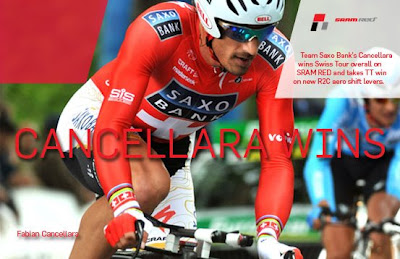
Extension of positive attributions based on performance : In this example of self-marketing, the message seems to imply that just because Fabian Cancellara won the Swiss Tour, the product offered must be great. Well, what are the odds that he couldn't have done the same on another competitor's setup? Courtesy : SRAM.


The point here is that it isn't very likely that one would make positive attributions about such things if past performance wasn't known. Because with no certainty can you say that your prediction for the Tour winner can time trial faster or 'hang on with the bunch' on the climbs better than say, rider number 9 in that obscure European team over there. Neither can you attribute with certainty that his team fares better than the other, or his coach is greater than the other, just because he won a race. All this can change. Follow on.

From a statistics perspective, every winning cycling performance should have two components to it. A) The racer's true ability. B) Chance. Chance can be any random event. It could be bad weather, mood fluctuations, an untimely crash, good luck (being in the right place at the right time), the presence of race radios, a mechanical failure... almost anything that could influence the race one way or the other.

The principle of 'regression to the mean' says that today if someone gets podium, tomorrow, they could finish somewhere back in the bunch closer to their true ability. By the same principle, someone who's having a slump can outperform his rivals in the next race, driving his performance closer and past his true ability. This is a scientifically validated phenomenon and I urge you to do further reading on it.

But a number of media journalists suffer from not heeding the role of chance. If someone wins once or in streaks, they'll go after him, his winning bike, his family, his coach, his nutritionists, his team mechanic etc and write excellent things about all of them collectively. This is journalism in retrospective - making positive comments about someone or something after a positive event has happened. In the process, the winner's bike, the bike manufacturer, his manager, his coach and his coaching service, his sports drink maker, his sun glass manufacturer...everyone are in for the limelight and big bucks.

There is a great deal of money to be made and lots of sales potential in this exercise. Sadly, the other folks who also raced in the peleton are veiled in absolute obscurity and we may never come to know who and what their backgrounds were.

There is a natural variation and fluctuation to events in our world that could be seen by sports analysts and fans as the true thing when its not. Random events can make one rider unexpectedly lucky on one day than the other. But the natural world has it that this luck will soon subside and an individual's performance will fall down closer to his actual norm.

Not many consider this role of sheer chance, and randomness in race outcomes. Why? Its plainly boring and too erudite, I suppose. There's no story in it, is there? I think in every sporting fortune, we as humans love to hear a good superhero fairytale. We're made that way. We like to make superheros, superhero stories, and idols out of these individuals. We also like to spend a disproportionate amount of time talking about them.

There are also innumerable books written on superstars, their race winning strategies, their mental prowess, the odds they overcame, their nutritional preparations, the amount of detail and attention they devoted to their bikes etc. Some of these books promise similar results if their readers would stick to the rules mentioned in its pages, while failing to discuss or explore an important topic in our natural world, that of the statistical nature of performance.

Having said this, I'm tempted to discuss the role of regression to the mean, and random events in the life of George Hincapie at the Paris Roubaix (where he tried to ride for himself to win). We could do that another day, I suppose. But feel free to take it upon yourself to analyze his past results. Find out what happened, and why he never won the Queen of the Classics to this day. Check out the variability in his performances. He probably rode as hard in every one of those races as the previous one, but something caused him to be in the top 10 one year, while pushing him beyond 50th place in another.

Its time we appreciated the hidden roles of these events before we stick the superhero label on one rider rider, or disapprove another for a poor show. Let's embrace everyone alike who's racing in this year's Tour. Its one of the greatest human endeavors of our time.


* * *

Monday, June 29, 2009

16 Bike Shop Dreams

"As long as you're going to think anyway, think big."
- Donald Trump

Be cautious. Have you ever found yourself, that day, fooling around in the bike shop, looking at mediocre bikes with modicum price tags when a clever little salesman decides to reel in your interest by quoting Donnie Trump (see above) ? And then he escorts you like a long lost brother towards a sleek and voluptuous looking bike hanging on the wall at the premium end of the shop.

Your eyes suddenly widen and you stare at it for a long time. You are entranced as it captivates you in a spellbind. You are gaping like a hippo. You are literally drooling from the mouth. There is a puddle of it near your feet. Now there is so much of it that it has become a scaled down human version of Lake Baikal.


Ofcourse, in no way is he asking you to make the purchase. You see, bike shop salesmen have an innate sixth sense. Without much physical contact, they already know how worn out your wallet is, the amount of cobwebs residing inside with its intricate architectural designs, that black and white photo of you in front of your house before you couldn't afford it anymore and it was foreclosed, those finger print grease marks on it from the engine of your vintage automobile that would spontaneously combust into flames when it was driven in the sun, those business cards handed to you by sympathetic employers after interviews with "Don't Contact" handwritten behind them, that credit card whose magnetic stripe won't work anymore due to the mountain of overflowing debt, those food ration stamps creased and folded so horribly that an art connoisseur would mistake it for Origami and may actually even offer you a price for them....

..Sigh.

Like a child who first wet his bed, you slowly furnish him your embarassing wallet with a strange sort of smile. Perhaps blue from shame, the last thing you do to save yourself is flick the lone green colored penny from in there like David Blaine the magician and quickly wipe it off with saliva to clean the copper oxide.

"Its okay, " he says in a morose tone and pats your shoulder. Then he points you to the door as he turns around to help another customer. His face has a smirk that you never caught properly.

"The exit is that way," he finishes off.

Its high time school textbooks corrected themselves. Mayflies don't have the shortest lifespans.


* * *

Thursday, June 25, 2009

36 Deceleration And Force Of A Helmeted Head Impact

For a final post this week, I'd like to make you wonder what it is like to slam your head bolt on in an accident while cycling. The agenda is objectively put some numbers out there and give a feel for things, using myself as an example. I'll show you how you can do the rough math yourself without much paper and ink.

So I went over to the shelf and grabbed my utilitarian Giro bike helmet to see what the foam thickness on it would be. It came out to about 1.8 inches, so let's take it as 2 inches for sake of simplicity.

Now say one morning, I'm out riding my bike at 25mph on my street. Suddenly, out comes this mad old lady from hell, backing out of her driveway in her car without spotting me over her shoulder. Unable to react quickly, (yeah I had a hangover from last night) I can't swerve away in time and CRASH I do right onto the vehicle, with my helmeted head slamming onto glistening sheet metal.

My head just decelerated from 25mph to 0mph in seconds. What was my head's deceleration? Let's assume it is constant deceleration for an ideal condition. The best helmets should offer this condition.

Avoiding lengthy kinematics derivations, remember this equation for constant deceleration :

where

a = deceleration of the head with a negative sign

vo = initial speed = 25mph ~ 36.7 ft/s

d = distance the head moves after impact before coming to rest, which is the distance the foam crushed = 2 inches = 0.167 ft

Plug in the values and you get a = -4032.6 ft/sec^2 ------------> A

The acceleration due to gravity on the earth's surface is 32.2 ft/sec^2 -----------> B

Dividing A by B, my head just experienced a constant deceleration of 125 times that of gravity (125 g). That is after wearing a helmet!

If you look at the equation for deceleration above closely, the 2d term is in the denominator. Hence, the bigger thickness of foam you have, the lesser the deceleration becomes. If I had 2 times the foam as I originally had, my head's deceleration would be close to halved and I would have more distance to 'take' this deceleration over. But too much foam thickness doesn't yield a good helmet design as it can cause a host of other problems. So there's a trade off. You will also appreciate the fact that since the velocity term is in the numerator, the faster I go, the more g's of deceleration I experience.

So what about the force my head experiences during this impact? Well, here's another simple equation for you to remember, derived from the work and change in kinetic energy relationship :

where

m = mass of my head and F is negative in sign indicating a retarding force

Say my head weighs about 10 pounds or 4.5 kgs. Now (vo^2/2d) is simply acceleration we found above, which is 125g. Multiply that with 'm' = 10lbs and you get something in the order of 1250 lbs of retarding force smack against my head. To put that into perspective, that's half a metric ton hitting me right where I don't want it. What makes this so uncomfortable for me, even just to realize, is that its doing this to me in a fraction of a second. That fraction of a second yank on my head is a yank on my brain and its internal blood vessels.

The thing to realize is that 125g of force maybe enough to cause brain injury, leave alone anything higher than this. Rarely is constant force ever experienced in a real collision. A more realistic model would perhaps be force following a curve, reaching a peak when the foam is close to being fully crushed. Hence, the ideal helmet assumed here is sort of...well, ideal. As comments have told me, I acknowledge that this is a simplistic model that does not take rotational characteristics of the acceleration into account. Rarely does an impact between the helmet and the road go through the center of gravity, hence causing rotation of the head.

Another thing you will appreciate is that if I were without a helmet, there would be no soft landings at all. If epidemiological evidence suggests that, on averge, chances of serious brain injury are reduced by a factor of 5 by wearing a helmet, I get a big zero by not wearing one. Lost out there, didn't I?

Having said all this, I sincerely believe that in the coming years as we push the frontier into new materials, we will come up with better solutions for this energy management problem in helmets. We will realize the goal for softer landings, constant decelerations and peak forces of lesser magnitude. Until then, we are struck with what's out there in the market. Some of these helmets are improperly designed. On one hand, too stiff foam liners are used that break catastrophically on impact instead of crushing. On the other, to satisfy the goals of lightweight designs, there is also a tendency to select low density foams that absorb much lesser energy than what is required. Hopefully, these issues wil be addressed soon to give sportspeople the protection they need to keep their heads right.


ADDITIONAL READING :

How A Bicycle Helmet Works

How Bicycle Helmets Are Made (Video)

How Materials Are Selected For Helmet Foam Liners [An extract from Gibson, L.J. and Ashby, M.F. 'Cellular Solids, Structure and Properties', 2nd edition, Cambridge University Press (1996)]

Anatomy of the human skull

Engineering Aspects Of Human Skull Fracture (University of Tokyo, Japan)


* * *

Wednesday, June 24, 2009

10 How Its Made : Tokyo Underground Bike Parking

Readers will remember that I blogged last year about the brilliant underground bike parking system made by the Japanese at Nishi-Kasai Station in Edogawa, Tokyo. I just happened to discover a cool video from Japanese news broadcaster Newsline which details how one of these these automated parking systems, called Eco Cycle, was designed & constructed and the machines which were employed in the process. This really looks to have been a neat little civil engineering project for the developers - Giken Seisakusho Group.


A picture of Giken's 'Silent Piling Machine' which takes prefabricated structural piles and presses them into the ground at high pressure without vibration and excessive noise. Courtesy Giken.


ADDITIONAL READING :

How Servomotors Work

Deep Foundation Construction

Tuesday, June 23, 2009

17 Efficiency In Inefficiency


Cycling is said to be an efficient mode of transport, when compared to running or driving a motor vehicle. Agreed. Mile for mile, far lesser calories and energy is spent, far lesser pollution emitted. But might that idea topple upside down when the road heads uphill?

When road grade rises, there is a seesaw effect in the amount of resistance wind and gravity play. Wind drag now goes down resisting less, and gravity comes up slowing you considerably. All that matters now is how much weight you carry and what gearing you have on the bike. The same gearing that perhaps tripled your speed output on a given rotational crank input on flats will plunge on a steep climb. If you choose to go with a lower gearing, your speed drops. So there is an apparent tradeoff there.

But it stands out, I guess, that one of the obvious elements of cycling athleticism - this notion of how good a cyclist someone is - is by assessing how well they can climb steep roads. Some of us may have this thinking that we're a real cyclist if we climb, and climb steep. I think there's a certain attractiveness in this tiring act. It gives one a sense of accomplishment, and sets a certain level of worth among the people he or she rides with. Bragging rights, yeah that's what it is. Besides, there's always a great view or a downhill to be earned at the other end, isn't there?

Top races in the world are most often won on the steep climbs, when a competitor can easily put time on his rivals. Stars who often showoff their talent on the climbs gets us all motivated to climb, and do it without getting off the bike. Getting off the bike and walking is somehow regarded shameful, powerless. You're no good. You aren't born to do it. Now where a cyclist does show mettle and talent on high gradient climbs, I think more can be said about his physiology and mental faculties than about the efficiency of his activity.

Its interesting that throngs of cycling fans line up steep cobbled roads and alpine climbs in Europe to see their favorite hero drag along the climb at close to walking speeds. Say one casual observer stepped back for a moment and asked : 'How efficient is cycling uphill compared to doing the same on flatland?', what do you think he'd tell himself?

I think the above observer could determine that this cyclist, riding past him on such a steep hill at 3mph, heaving from side to side zigzagging across the road like a detracked choo-choo train, will be more efficient if he got off his bike and pushed it uphill. There's no shame in this. Its just the clever thing to do, for this observer could jog up faster than the cyclist dragging along uphill! I would think much lesser energy is wasted simply caressing the ground with your feet than having to go through the complex motion of pedaling in circles with a chain and derailleur system that ultimately transmits some power to the rear wheel after losses through friction and deformation of rubber tires.

But sporting activity wouldn't have that, would it? Its not considered sporting otherwise. There might be booing from the crowd. There's no athleticism is walking your bike uphill...c'mon now. You're a sissy. You lack mental prowess.

Cycling does have its inefficiencies (perhaps that is why our early ancestors didn't swim out of the ocean carrying bikes to land). But it is the level of efficiency inherent in the cyclist which he applies to get past the natural inefficiencies that come into play in this mechanical activity that ultimately determines his outcome in a race, a training goal or the worthiness and respect he has among his peers. But I'm not the guy is the white lab coat so I can't credibly tell you where this bodily efficiency lies or how to attain it.


ADDITIONAL READING

Transport Efficiency

* * *