Tuesday, August 18, 2009

26 The Machined Death Of A Water Bottle

Sometimes, peculiar things happen to us. And we like to report it. Today's peculiar story to you is a minor tragedy to me. And there's an interesting causality to it, like all events in the world around us. Let me briefly show you causality.

I had a desire to ride my Trek T1 fixed gear bike for 2 hours today. I had an appointment in the afternoon so I was in a hurry to get out of the apartment in the morning and complete the ride before then. So I donned my cycling spacesuit and filled a single Camelbak Podium with some plain orange juice, sticking it into the seatpost's water bottle cage made by Profile Design (injection molded nylon/fiberglass).

Anyway, so I head off for the ride, cruising at a good cadence on 44 x 18T gearing. The road I usually start off riding on had some construction work on one side of it today. The modest traffic was being diverted to the other. I maintained my pace but rode over two unexpected depressions in the road. I believe those people were making road bumps of some sort and I take it that they usually begin life like that - a half done, torn section across the road about 10 inches wide and 1-2 inches deep before they're filled in with a mound of asphalt (??) I faced an uncomfortable, jarring ride over those two, risking a flat. Boom, and then... boom.

20-30 minutes later, I arrive at a local park slightly out of breath and decide to sip some of that juice. Now I have grown so used to grabbing the water bottle from out of the seatpost bottle cage that I usually don't fumble much and don't give it a second thought. This time, surprisingly, my hand couldn't grab onto a bottle. Hmmm....was it still there?

I get off the saddle to check where my bottle was. Yes, the bottle was there alright, but it was a strange sight. It looked exactly like in the second picture below, reproduced for you after I returned home.


This is how I remember having placed my water bottle before heading out of home to ride.


This is how I found it in the park.


Whoa, whoa, what's going on here. How did that happen?

Let's see. If you were really observant, you'd have noticed 4 different things from the above picture. Atleast I did in the park when I got off my bike to inspect my water bottle. Yet, they are all connected. We will then tie a common thread across them and look at causality. Let's look at the picture above again.


1) The bottom of the water bottle was finely touching the rear wheel and tire. No wonder I couldn't get my hands on the bottle. Its perplexing that I rode my bike for 20-30 minutes with a bottle touching my tire.


2) There was a pronounced crack on the upper stem of the bottle cage. Hmmm?


3) One of the two fastening screws of the cage is missing. Ahhh. Okay, so now we can tie a thread across 2) and 3). It perplexes me as to how and where the screw might have popped out. I cannot answer that with certainty. It may very well have been that I started off the ride without a screw and I hardly noticed it, which is even more perplexing because I'm observant about these things.


4) And finally....holy Vitamin C! My orange juice. Its....its...gone!


Can we tie a thread across 1) and 4)?

Well, it turns out we can. Let me show you the underside of the bottle. Look closely.

The tire machined away a small section of the bottle. All the orange juice quickly escaped through it, leaving absolutely nothing in the bottle but some orange soup with road grit.


I have been trying to come to terms with how this happened. Here is a plausible theory, supported by observation :

The density of orange juice with pulp is more than that of water, about 1.2 to 1.25 g/cm^3. Because I was missing a screw in the bottle cage, the weight of the bottle stressed the plastic cage so much that it cracked the stem and compromised its holding strength. When I rode over two significant depressions in the road, the bottle slipped out of the lower base support and contacted the wheel and tire. I was riding at about 17-18mph so the tire, with a certain angular velocity determined by the gearing, started rubbing away at the bottle, producing friction and heat. Some of the juice started leaking out of the micro-hole. As the orange juice slipped out of the bottle and onto the tire, it attracted grit and sand from the road. With all those particles sticking onto the tire, the tire was now a very good abrasive. As I pedaled, oblivious to the fact that the bottle was touching the tire, the tire had become a very good machining tool and shaved away a portion of the bottle, enough to get a clearance for the tire to pass unobstructed. Finally, when I stopped to check the water bottle at the park, all the juice was gone. The grit was stuck onto the tire.

Big things happen from a combination of little things, a train of events. It is interesting to be a casual inspector and study the hows behind these events. In this case, my haphazard use of a water bottle cage cost me a nice water bottle. Now to find out how I lost that screw......


Do you have any stories to share? Write to me here.


* * *

Sunday, August 16, 2009

4 Using Computer Aided Manufacturing To Make Titanium Frames

Ever since the start of this month, Lynskey Performance Bicycles based in Chattanooga, TN has been quietly uploading videos of their manufacturing processes to the internet. As you know, Lynskey is the founder of the brand "Litespeed" which goes back a long ways. If I'm not wrong, it is now owned by another TN based company, American Bicycle Group (ABG) which makes the featherweight Ghisallo frame (weighs about 1.7 pounds). Did you know that apparently, even NASA's Jet Propulsion Lab buys tubing from ABG? I didn't want to shift topics, but something like that really speaks for the quality of titanium tubing these companies deal with.

Now in the past, I have showcased some history of the machining technology David Lynskey used in his Litespeed facility on this blog, so click here to read that article if you haven't. Today, Lynskey works with U.S. milled aerospace grade 6AL-4V and 3AL-2.5V titanium and each bike is handcrafted to customer's needs using some special technology.

After some interesting hunting, I learnt that two new Mazak machining centers (CNC milling machines) were installed at the Lynskey facility. One is a Quick Turn Nexus 200-II and the other is a Vertical Center Nexus 510C-II. These babies are "the Cadillacs of CNC machines". These options will give them design and manufacturing flexibility, productivity and time savings.

In the following sample video, we can see the 5-axis tool path in creating a fork dropout and a headtube badge. This is actually created in CAD/CAM which generates the NC machine code, which is then fed to the Mazak machine via Ethernet cable. The machine now knows "what to machine" and "how to machine" it. This is one episode in a series of videos called "How We Make A Lynskey". I encourage Lynskey to go ahead and keep showing normal customers what role these machines and tools play in the big scheme of things. There is great value in not only purchasing and riding a certain variety of bikes but also learning how they're made.


ADDITIONAL RESOURCES :

Technology Helps Bike Builder Pick Up Speed
CAD/CAM Basics
Introduction To Machining
Ch 20 : Machine Controls from Tool And Manufacturing Engineer's Handbook
CAD/CAM Process Planning : A PDF Presentation from MIT
Can A Titanium Frame Be Reused After Fire Abuse? An Analysis

* * *

Thursday, August 13, 2009

4 How To Form Excuses On Horrible Climbing Shows

So your riding buddies trash talked you into riding some monstrous hills out somewhere in the exterior of civilization. But you've felt better on other occasions and boy oh boy, today is just not your day. If only bicycles were made like computers, we could all have an escape key before the bone breaking, lung chopping climb to hell. But there are no shortcuts to escape.

Hit hard...

So how on earth do you back up and slow down like a rock efficiently on the incline without hurting valuable pride and self-esteem in front of other people?

This, it turns out, is an easy one. Let me show you The Way.

Things you will need to carry in your jersey pocket :
  • -Pair of scissors.
  • -Wife's makeup. If you're a wife, then borrow your husband's makeup. Look in the garage.
  • -Cell phone.
Things you will need to carry on your back :
  • -A camelbak filled to the gills with water. (If it does not have gills, make sure you purchase one with gills)
As your attackers, a.k.a riding mates, slam down the pressure and leave you climbing slowly like an unattended VW Beetle, cleverly start launching the escape tactics. You may do any of the following or all for a combination excuse strategy (like those 2-D video game "COMBO" attacks)

1. Cell Phone : Quickly reach out to your cell phone and start calling people you never knew. Old uncles, old distance-relatives or grandparents are usually the best. They ramble on and on and on without direction and it won't matter much if you hang up on them. They'll never remember. Ask them questions about life and wisdom and pretend you're in serious conversation with the sage. Exaggerate your voice and follow your attacker's reactions. They'll turn back and look at you. Then they'll mumble amongst themselves in the distance, nodding their heads and acknowledging the fact that you're making a few business calls and that takes priority over climbing some stupid hills.

2. Makeup : Quickly reach out to the makeup box while your attackers aren't looking.
  • -Take a shade of gray or something and start coloring your hair on the sides. Use a helmet mirror for assistance. When your attackers look behind, they'll see an old, worn out friend struggling up a hill. But sympathy will usually turn to respect and disbelief. It is an unwritten code in cyclysm to encourage and respect an old dog who can climb.
  • -Take a shade of yellow and start coloring your face. When your pace is exactly below 4 mph and you risk looking like a dork on wheels, yell out that you may be coming down with a bout of Dengue Fever and you need to climb slower for it to go away. Pretend you're rubbing the disease away.
3. Scissors : So you're climbing like a dork today but you're showing off a kit that says 'Winner Of So and So Race' or 'Champion Of Ridiculous Time Trial In Town' or something along those lines. Kits musn't be shamed with bad performances from the wearer. It is a hurt to pride.

Quickly reach out for the pair of scissors. When your attackers aren't looking, snip away cool looking sponsor logos, titles, past honors etc etc...then form them into a ball and throw them into the bushes in the side. Make sure they roll off and away from sight. When your attackers look at you and spot your disheveled state, tell them you had a wipeout. "The front wheel shimmied!" They'll quickly slow down and come to your rescue. If they don't (jerks), they'll ackowledge that you need to climb more slowly because of this 'crash' they didn't see. Slow climbing performances will then be accepted without question. Onward.

4. Camelbak : Hydration forms the core of excuse making. Now don't get me wrong. This is not a hydration to quench thirst. It is a hydration to excuse forming. When the climb is about 5 or 10 miles away, quickly start slurping in all the water you can find from the hydration bag. Get to the front of your attackers. Then get off your bike and take a long pee. Start making a few whistles. Put on a grimace to show that its getting tight down there. Stay in that position for 3-5 minutes.

Your attackers will notice this and acknowledge that you slowed down naturally to take a difficult leak. You're not going to climb as fast as them. Atleast not today. They'll wait on the top of the hill for you.

Now that was easy.

But please be reminded that none of the above strategies will work if you see a road sign beside the official start of the climb that looks like this :


To your dismay, the advantage is now on the attackers' side. You either let the inevitable happen, or you slip out of your house in the black of night, drive your car to the climb, dig the sign out with a shovel and a flashlight and hurl it down a big cliff. Wear thick black leather gloves when you do this.


* * *

Monday, August 10, 2009

4 Kinematics of Bicycle Hub Internal Transmissions


An internal bicycle hub is an intricate planetary gear mechanism and is made of dozens of small parts. See, long before the derailleur became a staple in racing bikes in the 20th century, internal hub gears ruled the roost. In those days, these beautiful devices offered the first practical ways to shift gears on the fly. What a godsend!


In order to fully understand this beautiful system from a technical standpoint, we need to study the kinematics. or motion of the gearing action.

Click to zoom up the following one page article which explores the dynamics of the gearing in a 3 speed Sturmey Archer planetary gear hub. It explains how "gear ratios" are obtained in a planetary hub system by following some simple 'rolling contact' principles of gear motion. I borrowed it from my one of my favorite engineering textbooks. I hope this will make you appreciate the science behind bicycle transmissions. Also, when you get a chance, open up a hub and check it out for yourself!


* * *

Saturday, August 01, 2009

27 The Rate Of Climbing Uphill Explained

I've noticed that some cyclists who have been introduced to the concept of the rate of climbing uphill falsely think that Michele Ferrari pulled this out of his own pocket, as in, he invented it or something of that nature. Negative. He only went ahead and popularized the idea, putting a confusing trademark name to it such as "VAM" and developing some of his own methods to look at it with respect to cycling performance. But the idea itself is rooted in centuries old elementary geometry and Newtonian physics. Click here for the history of vectors.


Let's have some *serious* fun with climbing rate. You'll start to see simple relationships that may finally make some sense to you as a cyclist. If you love analysis, this may be for you.

I'll show 5 different ways to study vertical speed, or rate of climbing. 3 of them are using math. The 4th involves using some field work with math. I'll show you what Tom Danielson's climbing rate was for the record ascent up Mount Washington and I'll also show you an error analysis done on it with an example, which is pretty important on anyone's estimations. Finally, the 5th method shows how using some devices do this all for you instead of number crunching.

Let's begin. Enjoy over a cup of tea. If you see something fishy, I welcome you to call out any errors in the proceedings.


METHOD I - A Power Perspective

The overwhelming portion of total propulsion power in Watts needed to just climb uphill on a bicycle is given by the following relation :


9.81 = acceleration due to gravity on earth's surface (meters per second squared)
M = total mass of a bicycle and rider (kilograms)
Vg= ground speed (meters per second).
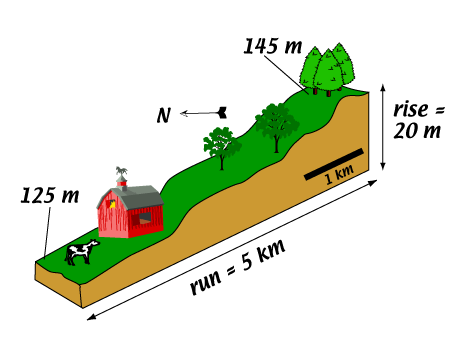
G = grade of hill, expressed as a fraction = (Rise/Run). To see a graphic of what rise and run mean, click here.

This is only power for climbing and does not include power to overcome wind and rolling resistance, drive-train losses or power for acceleration.

Note 1 : For steep grades, instead of simply (Rise/Run), G should be replaced with :


To put into perspective, at a steady 10% gradient, error % between the small angle approximation of (Rise/Run) and the real formula above is about 0.5%. At a steep 20% grade, it is 1.9%. At a near to impossible 30% grade, it is 4.2%. At a vertical asphalt of 45% grade, the error is way off at 9%.


Rate Of Climbing Broken Down

Now if I were to take the above power equation and break it down into 2 little packages, here is what each package would mean in a practical sense.


In other words, power equals the product of a force (total weight acting downwards) and vertical speed, which in other words is the rate at which you cover vertical distance.

Let's take the second package, the climbing rate.

This is it. Its a beautiful equation. Its units are in meter/second and you can convert it to meter/hour. 1 meter/second = 3600 meters/hours. Its also called VAM by Ferrari, which may be a pretty confusing term to people.


Practical And Theoretical Limits Of Climbing Rate

The equation for climbing rate, with G substituted, is :


If we chuck out the sine function using an overhead crane and plot it, it looks like the following :

Fig 1 : The Climbing Rate Curve for a ground speed of 1 m/s. Cyclists climbing on human power alone can only use a tiny portion of this curve above y=0, ranging from 0% grade to 40-45% grade.


In the linear yellow region, any point on the curve can be given by the equation (rise/run) with negligible error. I have chosen about 10-12% for the upper limit of the linear portion. For any hill grade above this, its better to represent G in the power equation with "Vg.sin[arctan(rise/run)]" than just "Vg.(rise/run)" to avoid errors.

Also notice the point on the curve that signifies 45 % gradient. It is impossible to ride efficiently above 40%. After 45% is the curve signifying landslide possibility, which cannot be attempted by any cyclist. This is the upper limit for practical climbing rate.

Observe the upper and lower limits of the curve in blue. They are called asymptotes because the curve tends to approach towards them but never reaches -1 or +1.

The effect of the ground speed term Vg (other than 1m/s), when multiplied to this sine function f(x) will be to stretch out f(x) like a rubber band and extend the upper and lower limits of the asymptote to -Vg and +Vg. What this is telling us is that if a cyclist's ground speed is, say, 5 m/s (11.2 mph, 18 kph), his climbing rate cannot go below -5 m/s (-18,000 m/hour) or above +5m/s (18,000 m/hour). These are the absolute upper limits of theoretical climbing rate for his given ground speed of 5m/s. Its the heaven and hell of climbing. Both are impossible. (Whether hell is above or below is upto you to decide. I think in climbing, hell should be above!)

Note 2 : If grade kept increasing and increasing, do you think gravity will actually allow you to keep climbing on your own power? In other words, would rate of climbing keep on increasing with step increases in % gradient, as Ferrari's website may have you believe? Yes, it does. But there's a limit where we can't go further and vertical speed drops to zero. As you ascend uphill your muscles have to supply the power to increase your potential energy. It doesn't come from thin air. Eventually, you will become tired. Your mechanical gearing advantage will decrease as you have a finite set of gears. Your speed will decrease exponentially and at some critically steep grade possibly 40% or more, your velocity will be reduced to near zero and you can roll backwards or fall. It doesn't become efficient to propel yourself anymore. See Fig 2 below. This is why I argued in the past that on very steep grades, it is more practical energy wise to get off your bike and walk. Why? Because the speeds are more or less the same cycling or walking!

Note 3 : Human muscular power is also very different from electrical motor power. The capability of a human to deliver bicycle propulsion is a function of time before becoming exhausted, also called endurance time represented by the symbol tau (T). Every individual has a power curve (Watts vs Time) that generally curves downwards from left to right. It tells us that high power can be sustained for lesser time than lower (but slower) power output. It is very unlikely that a high climbing rate can be sustained for a very long time through human power alone (unless you're some freak). This can be seen in the graph below.

Fig 2 : Pick a certain W/lb and while staying on the horizontal line, notice how your ground velocity Vg decreases drastically as you move towards the sloping lines representing higher grades.


Relationship Of Climbing Rate To Grade Inside And Outside Linear Curve

In the linear portion of Fig 1, a 10% relative increase in grade in the linear region (say from 7% to 7.7%) should theoretically result in a 10% increase in climbing rate. In other words, climbing rate is directly proportional to the vertical ascent and inversely proportional to the horizontal length of climb. So if we kept ground speed and run constant, a higher rise leads to higher climbing rate and vice versa. Say we doubled the ascent, then climbing rate is double the initial rate. Conversely, if we kept ground speed and rise constant, a longer length of climb will decrease climbing rate or vice versa. Say we doubled the length of the climb, then the climbing rate is halved from the initial rate. If we halved the length, the rate is doubled.

Outside of this linear curve after about 10% gradient, a 10% relative increase in grade (say from 17% to 18.8%) should only result in a 3.8% increase in climbing rate. So even though climbing rate increases, it doesn't increase as much due to the nature of the curve above. You can see how its trying to level off.


An Example : Andorre Arcalis 10.6 km, avg. 7.1 %, catégorie HC

We can take the profile information of the ascent to the ski resort of Arcalis and compute our climbing gradient for each kilometer using kilometer specific gradient and kilometer specific ground speed. The grade isn't steep, hence you can use G = (rise/run).

Do this for all 10.6 kms, add them up and take their average. You should end up with an approximation of your total climbing rate for the mountain. Here is first example done for Kilometer 1 :

Fig 3 : Km by Km Calculation Of Climbing Rate. Click to zoom in.


METHOD II - A Geometric/Vector Perspective

If you remember some vector theory, you know that any vector can be resolved into component vectors. In our 3-D world, the velocity vector of a cyclist uphill can be resolved into an x-component, y-component and z-component velocities. For the sake of simplicity, if we looked at it in 2-D, it would look like the following. The upward velocity component is the climbing rate or vertical speed. Refer to the equations on the right side to solve for these Cartesian component vectors.

Fig 4 : Resolving Ground Speed. Click to zoom in.

Try to visualize this picture of blue, red and green arrows in your mind as you imagine the cycling moving uphill. The length of each vector signifies the magnitude of the speed. As the cyclist changes speed or accelerates, the length of the ground velocity vector changes in real-time and so will its components since they're all connected. Once the cyclist approaches the downhill section over the other side, the direction of ground velocity vector points downward and its length increases because of the action of gravity and the quickening of pace (until terminal velocity is reached or above). The vertical component will then point directly down and its length signifies the descending rate.

Note 4 : In the real world, since we have a third vector for the lateral swaying/zigzagging motion as you climb a hill, the climbing rate calculated from 2-D resolution of vectors would be some percentage off from the real value. This is the error resulting from simplification.


METHOD III - A Time Perspective

Suppose you don't care for any of the above nonsense to calculate your climbing rate, you can still find it out using your time. Go out to a climb like Mt. Washington in the United States and time yourself using a stopwatch. For example, back in 2002, Tom Danielson set an unbeaten record of 49'24" for the 1432m ascent at 11.9% ave.


Plug in what we know for Mt. Washington. Ascent = 1432 height meters. Climb time = 49.4 minutes.

Tom's VAM estimate from time comes out to 1739 meters / hour. If you want to break his record, you need to aim for round about this vertical speed. Else... you can sit at home and eat ice cream.


Climbing Rate Error Analysis

Now we all are human beings. Our stop watches are not very precise instruments. And when someone tells you that the ascent in meters of a mountain is "x", what is the error in it and how does it propagate into the final climbing rate calculation based on Method III?

Well, that is simple. Here the error equation :

where :

δClimbing Rate = Error in climbing rate (meters/hour)
δAscent = Error in ascent (meters)
δTime = Error in time measurement on a device.

Lets put this into perspective. Lets just suppose that the person who measured Tom Danielson's climbing rate was 50 meters off in his estimate of the total vertical climb and there was a time measurement uncertainty of 0.2 seconds or .003 minutes (20% of least count of a watch of 1 sec is a good rule of thumb). If we plug this into the error equation, we get :


What this is telling us is that because of the uncertainties in the vertical rise of the climb and time taken in our example, the uncertainty in Danielson's climbing rate (or VAM) is 103.8 m/hour. The relative error is then a 6% error in the initially calculated figure of 1739 m/hour.

This is just an example, mind you. I did not declare that someone estimated the ascent 50 meters off the real value. Yet, this shows that its important to do an error analysis on anyone's climbing rate measured out on the field. Michele Ferrari does not show an error analysis on his data presented on his website concerning this year's Tour de France. People are bound to look at inflated values and declare, "HE DOPED, HE DOPED!! CATCH HIM!"


METHOD IV. An Analytic Perspective

If you still want to dig deeper into some relations using the power of partial differential equations, see Dan Connelly's page on an analytic treatment of climbing rate. You get more mathematical ideas and can do more cool things with it. Dan is a semiconductor engineer from California and like all engineers, loves his number crunching.


METHOD V - A Device Perspective

If you think math and science are beyond you, then spare some coin and try a nifty little device called a variometer, or vario for short. Paragliders use wrist-mounted variometers to check their vertical speed and altitude. This is an expensive but lightweight gear. It uses electronic pressure sensors to sense the change in pressure around them. Since there is a correlation between pressure and altitude, it is possible to calculate instantaneous rate of ascent or descent. For example, between the foot and the peak of the Arcalis climb, there is approximately 0.08 kg/cm2 of pressure difference.

The one shown in the picture, made by a company called Ascent, displays vertical speed with adjustable averaging (m/s or ft/min). Its resolution is 0.1 meters/s or 360 meters/hour. It can record data for 200 'flights' and has a rechargeable lithium-polymer battery with life of upto 10 hours or 4 hours standby time. Because a cyclist's vertical speed range is so small in comparison to a paraglider (the speed range of a paraglider is typically 20,000–60,000 metres per hour), such a device may even be impractical. Here's a video of how it works. I have not used one so it'll be interesting to find out whether they work in any useful manner for a cyclist.
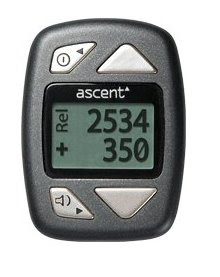
Fig 5 : Ascent Vario, $250-300


Another option is the Avocet Vertech II Alpin which is built for mountain hikers. It is claimed it can show you current climbing rate of range 0 to 28,000 feet per hour in with 100 ft/hour resolution or 30 meters/hr. See other features here.

Fig 6 : Avocet Vertech II Alpin, $250


A reader also commented that Mavic's Wintec Ultimate cyclocomputer that costs about $200 can also show you vertical climbing rate, but I cannot confirm this.


ADDITIONAL RESOURCES :


Power To Weight Ratio
Air Pressure And Altitude Above Sea Level Reference Table
The Standard Rule For Climbing Bragging Rights
Contador's Climbing Rate & Power to Weight Ratio on L'Alto de Angliru (Spain)
Error Propagation


* * *

Tuesday, July 28, 2009

70 The Church Of Lance Armstrong


Over the past couple of years, I have been sort of a silent surveyor of the emotions people have for Lance Armstrong. You need not go to Austin, Texas for this privilege. Its right here on the internet.

While Mr. Armstrong's Twitter account is bludgeoning with over 1.5 million followers, fierce wars are being waged in forums, blogs, news websites, sports commentaries, opinion columns and even video sites like Youtube and Metacafe. I wonder if the numbers of people and the sheer amount of time spent/wasted in these 'word battles' make any sense to a casual observer at all.

To give you a small perspective, take Yahoo Sports for example. On stories such as this one in YS, the number of comments from people who were interested in trading and exchanging the war of words on the topic of who was right and who was wrong is easily over 1900. Yes, you read right. One thousand nine hundred comments.

Now, if you go through such comments like you slowly flip the pages of a fat book, you can sort of arrive at a general trend of what people are thinking. This trend has been overwhelming many websites. People are all thinking in this direction. Its the number ONE herd attitude that has been behind the persona of Armstrong.

If you have read these comments or have experience in dealing with them, much of them hold one underlying thought process, which may be associated with a fallacy of the human mind. Its a cognitive bias and I talk a little about it towards the end of this post.

I won't call out anyone's specific comments, but lets see what that dominant herd attitude is...put in my own words, in a clean and decent fashion, without tears, yells, screaming or inappropriate language :

"I'm a huge fan of this athlete and you sir, are wrong if you aren't. If one is a survivor of a disease that has touched many, has achieved a great athletic feat in sports successive times and has managed to bring huge amounts of recognition for the sport and money along with it, that person is simply too great and should be automatically immune from criticism or have the privilege of being reserved from criticism in spite of shoddy behavior. This is because the sum of the parts are excessively good even though the individual constituent parts maybe bad, as you say. You are simply jealous of someone else's success."

Let's substitute the appropriate words for the general terms :

this athlete = Lance Armstrong
disease that has touched many = Cancer
recognition for the sport = recognition for cycling

This is the underlying idea. Simple.

Now I don't know if there are any readers of my blog out there who are neutral about this Armstrong phenomena or entirely against his attitude. But if you are, you know that the above sentences are what is being fed down your throat over and over again. It has been blended like juice in many forms and has different variations but the recipe is the same. It doesn't matter how much scholarly criticism you round up against the figure of Armstrong. It doesn't matter which objective sources of information you cite for your arguments. You will get the same juice from the 'followers' to drink.

This is the herd behavior because it also rubs on other people like a virus and soon, they all begin to think alike, even though they have not done their own research on who they are voicing for. Its like fashion. Today something new comes along, quick start believing in it. The blind fanaticism then runs like a pandemic.

Now it doesn't take much to see that this blind fanaticism over one man has obviously taken religious proportions. And there are consequences if you don't follow.

Many of Lance's detractors may have come across a certain stigma in the public. What is stigma? It is a state of being discredited or rejected in society. And here's the cause of that stigma : If you don't like Lance Armstrong in your circle of friends or any group of people, then its likely you're somehow viewed as not being religious. You don't fit in the herd. There must be something wrong in your head.

The religion here is that of supporting the fight against cancer through the faith and and a Herculean worship towards Lance Armstrong. It is a religion because its followers are bound by its ideals and to thinking, talking and having faith in the powers of a human demigod, a personality behind this disease, all the time. You are not to criticize, only support no matter what the circumstances.

To signify you are part of this loyal cult, you will engage in exclusive practices such as wearing yellow and black, an elastane wristband, donating lots of money to his charity, taking part in his mega charity rides, all this while carrying high the torch of the day the demigod survived cancer. You may even build a shrine for him, right in the neighborhood gym or at the local bike shop where you will adorn the walls with lots of pictures of his face or his sweaty body riding a bicycle.

While all this is going on, the demigod high the throne of the food chain being adored, loves the adoration so much that he becomes a full time narcissist, converting the adorers into money and further adoration. Its a perpetual cycle. If he can't do this himself, there are others on the royal bandwagon to help in the process. They then take a share of the pie too. $$$ !

Whether you consider this religion good or bad is up to you, but it is a cult considering the size of the adulation, the inflated fascination towards one individual and the sheer number of his followers.

If you're a detractor of the religion, you could be easily viewed not only as a detractor of the god, but as an atheist to this goal, this ideal, this philosophy of the fight against cancer. You don't recognize that he came back from the dead, you don't recognize that he is the savior, you don't recognize that he dominated in a sport after he resurrected, you don't recognize that he has the power to save people from death because of his fame and power. You may not even recognize what cancer is!

Now sit back and think. Which other great story has a parallel to the story of Lance. Maybe not literally, but still? Jesus Christ rose from the dead, 3 days after He was crucified. And then He promised He would return to save the world and provide salvation to those who believe. You're a Christian if you believe in Him and have a one to one relationship with Him, if you believe in what he can do for you. Billions believe in his power to heal and to work miracles in their life or anyone's life.

The name of Christ has been associated with one of the greatest victories in the history of human civilization. It has been associated with the greatest battle yet to come. It is one of the holiest of the holy names. Yet, lets not forget that even such a revered individual and prophet such as Jesus Christ has not been immune to criticism. The Holy Bible has been turned upside down and inspected with the greatest precision and critical eye. Detractors, such as Richard Dawkins, are celebrities today. Its a little ironic, but he happens to have his own big following.

If millions believe that Jesus has the power to forgive your sins, protect or cure you and fight evil, are you looked upon as a bad person if you fight Jesus and his followers? What gives you the monopoly to think that Jack is wrong and morally a bad person if he does not follow what you believe?

In other words, if Jesus Christ and the Bible can be debated in a sound manner as is happening in many educated circles today, why not Lance Armstrong?

Well. Uh-oh. It doesn't work that way. In fact, if you do the same against Lance Armstrong, you're a jerk, a dick, a piece of shit, someone who doesn't value life or success and is a hater for the fight against cancer.

Really? Never has been the word 'hater' so overused and out of context. Who talked anything about cancer here? We're talking about the man. We're talking about his personality. We're talking about his wrongdoings and serious misdemeanors that need a place for focused, intelligent discussion.

Nope. Not allowed. ACCESS DENIED. We will delete your comment. Our management will have you banned. He fought cancer, he's a cancer survivor. He won the Tour de France 7 times. Sorry, we believe in him and We're Holier Than Thou. You will hereby be an outcast.

Sadly, when celebrities and their egos attain larger than life proportions, so do the fallacies in the minds of their followers who engage in this hero worship, a cult phenomena. It is largely termed as cognitive bias. Confirmation bias is a type of cognitive bias. This refers to a form of selective thinking that focuses on evidence that supports what believers already believe while ignoring evidence that refutes their beliefs. You can see it in all comments on all websites in support of Lance Armstrong. This will be a wonderful terrain for those of you interested in social psychology experiments. You can see it happening from a distance. You can study it. But you'll be wasting your time if you enter the Church and question its belief system.

All Hell will then break loose. Run for your life.

I suspect that the Church of Lance Armstrong was founded on the day he rose from death and defeated cancer. It is very real, and it is here to stay for a very very long time. Yet, thousands of people all over the world fight the disease with little fanfare and emerge as survivors. Who really gives a fish about them?


* * *

Sunday, July 26, 2009

70 About a Boy from Pinto


1. Humble Beginnings : Alberto Contador became a cyclist through his elder brother, Fran Contador. When Fran passed his Spanish entrance exams at school, his parents bought him a new bicycle. The old one, an iron Orbea that weighed like a tanker, was passed onto the scrawny little Alberto, who couldn't have complained that he now had a bicycle as well.

Riding with Fran and his friends through the wind swept corridors of Pinto, Alberto would always keep up with the group on that heavy bike, even though the wind blew his tracksuit top open like a parachute. Now Fran enjoys being his champion brother's main PR guy, secretary and financial manager. When he's not busy, Fran himself defends the family name in the Nissan Titan Desert across the scorching sands of Morocco. It is also known as the toughest MTB Marathon in the world.

2. First Team : Javier Fernández, who signed the teenage Contador up for the neighborhood team of Embajadores, said the following to El Pais about the young rider, "He was about 15 the first time I saw him, with that iron bike, which was completely outdated. He had a natural talent and strength, and broke away from the pack in a race that included Madrid's best young cyclists. It was obvious he had no technique, but also that he wanted to be a cyclist. Alberto had nothing. His parents couldn't even go with him to the races because they had to stay with his younger brother Raúl, who has suffered from brain damage since he was a child. Raul was always in his wheelchair."

The lack of money motivated Contador to value the little things he had in life. Whenever he did save up some money, he would spend it on new equipment to improve himself.

3. Brain Condition : Contador missed his first Tour de France due to an aneurysm in 2004, which, just two months before the race, almost killed him. While racing in the Tour of Asturias, he collapsed to the ground almost like Tom Simpson with severe convulsions. Doctors said that he had a congenital problem with an artery in his brain and they called it cerebral cavernoma. This balloon like bulge of the blood vessel can kill you if it ruptures, as it causes subarachnoid hemorrhage. Pathologically, it is red to purple in colour, appearing as a raspberry in the brain. There's a video here of a crash early in his career which shows him having convulsions as he lies on the road.

He underwent immediate surgery to prevent irreversible brain damage and this event has permanently marked him through a large scar and titanium plates on his head. How he survived the face of death is extraordinary, leave alone winning the Triple Crown of cycling and his 2nd Tour de France this year.

Contador has no special memories from that day, the coup de grâce for that entire season. But when asked, he does recall that the people who first attended to him on the road where he lay unconscious laid him on his back, a complete mistake as he could have swallowed his tongue and choked to death.

When doctors told him that he could start cycling again, on November 27 2004, it was 3 degrees and raining buckets outside. Yet. he still picked his bike and went out to train with new life because it felt like a privilege when before he might have been lazy to ride because of bad weather.

4. Health (A Ticking Timebomb?) : The internal scar left in his head makes that area of his brain so hypersensitive that he often has epileptic fits. Contador takes medication daily to prevent those fits, and pays regular visits to the neurologist. Pedro Celaya, the doctor at his past team Discovery reported that as he remembers, Contador was absolutely obsessed with not doing anything strange about his health.

Perhaps Lemond and other Contador grillers in the press may like to think twice about "firing" pressuring questions at this youngster in front of cameras and the whole world. Perhaps this is the reason why he tries to avoid needless questions that try to take his mind off racing. He remembers hospital too well and does not want to end up there again.

Meanwhile, ignorance about his condition among his detractors abound and they chose to do things such as labeling him a "doper" or asking him to account for error prone "VO2 max" calculations when he had a race to take care of. Others, such as Armstrong and Bruyneel, were happily applying both psychological and political pressure on him through means of Twitter propaganda and press media. An astute observer will have noticed that these two individuals, with the help of media, were trying to manufacture a certain tension out of the team, while Contador was coolly trying to save the situation by reporting back that everything was quiet, friendly and normal at the dinner table and that the ambiance in the team was very good. Is it too hard to guess certain elements around him were trying to mentally break him from the inside while he was trying to concentrate on his career? It didn't work as planned, although Contador stated several times that this year's Tour was very difficult mentally for him.

5. Wins, Riding And Attacking Style : Contador is an all-rounder. He has been a proven time trialist. He was Spanish Time Trial champion in the under-23 category in 2002 and in this year again. Plenty of other ITT wins range in between. He has represented Spain at the Beijing Olympics in the ITT and became fourth. He has nearly 50 professional wins, so he has plenty of experience and wins to prove it.

Consider this : He is aged just 26 and has won 3 grand tours in succession, plus a second Tour de France this year already. One more Tour win puts him in company with Bobet, Thys and Lemond, all legends with 3 Tour de France wins. He's also one of only 5 riders in history to have won the Triple Crown of cycling (all 3 Grand Tours) in his career thus far. In contrast, Lance Armstrong at age 26 (1997) did not have a single grand tour overall victory in his belt, instead he had two stage wins in two different Tours and was UCI world champion in 1993. Armstrong was in his 30's when he matched the number of grand tour wins Alberto has now. Armstrong has not won the Giro d'Italia nor the Vuelta a Espana, the other two Grand Tours apart from the Tour de France.

Contador is dark skinned and thick skinned, with long legs and a skinny upper body. He has a high level of muscular strength and endurance, while offering little frontal area for aerodynamics. He has been observed by Phil Liggett and others to time trial with similar abilities of Miguel Indurain.


Contador seems to launch his best attacks when he knows there’s a headwind and he can get five or six meters of gap between him and rivals. He snaps forward to try and break another rider's rhythm. Then he steps on the gas and continues to drive solo at a very high pace on the climb. Something about his effortless cadence up the climb just tends to psychologically dampen the riders behind him even more. Intelligent people on Science of Sport have calculated his vertical ascending speeds up mountains and the numbers that come out are like nothing the Tour de France or any other cycling event has ever seen before. Armstrong agreed in the press in the final days of the Tour that even he in his prime may not have been able to match the performance of Contador.

Contador loves to attack at the right moment and he trains to keep his speed up for a long periods of time. His rapid acceleration up climbs is virtually unmatched. The best battle to date where this was displayed was the man-to-man, balls to the wall racing between him and Michael Rasmussen on the slopes of the Col de Peyresourde in July 2007. This also happens to be his favorite climb.


Contador keeps his focus on the Tour, but unlike Armstrong, he keeps sights on wins in lots of races throughout the calender. He really enjoys his racing. He has also told the press that he would like to win one day classics in future.

6. Income : How much does Contador earn? Well, for the 2007 Tour de France winner's prize, he received an on-the-spot 600,000 dollars. Add to that similar amounts for the other three subsequent Grand Tours, myriad endorsement deals (eg, Sidi), contracts worth a million or two and air time on tv shows and all that...and you would bet he could buy a lot of fancy bike parts, or let his fiance pick two, maybe three designer handbags on her next mall visit. Or maybe he would like to help in treating his physically challenged younger brother? Whatever he decides to do, he has enough stash to repair all his flat tires with Euro bills for a long time.

7. Love life : Alberto goes out with a 23 year old, slim brunette named Macarena. She is a staple in Alberto’s lifelong gang of friends. She was fifteen when she met Alberto, who was seventeen. Nine years later they’re still together and now frequently travels to see him race and win the big ones.


Folks from Pinto are ordinary people who keep their friends and have faith in them. This concept has lost its meaning in America.


8. Hobbies : Contador loves hunting in his spare time. He has a fascination for birds, keeping personally bred canaries and goldfinches at home. He is reportedly careless about organizing his room and personal things but loves to clean his bike and keep it in great condition. Apart from cycling, he also likes to play soccer.

Contador has a blog. He has also been profiled by several of his fans who have seen him in person to be a very careful writer. He takes great care and exhibits a need for perfection to sign an autograph or write a few words for a fan.

It must also be mentioned that he loves hanging out the beach.


* * *

Wednesday, July 22, 2009

15 'Decommisioned' Bicycles & Their Waste Stream

Keeping in with our theme of spills, crashes, injuries and utter turmoil, it has always struck me as to what people do with their destroyed carbon fiber bikes after a crash. Do they trash it in the dumpster? Do they try their best and send it somewhere for a repair? Do they salvage some parts and try to use them in a different application and setting? What would you do?

This blog has shown you a number of instances in the past where bikes and bicycle components have failed. Now often there is a legitimate reason for these occurrences which I don't want to go into. But what happens afterward? What do you do with this pile of seemingly junk metal and carbon fiber?

Recently, a reader and fan of this blog - Anthony Hendrickson, with Materials & Process Engineering at Boeing Rotorcraft Systems, sent me a photo of his friend's high end Pinarello. This rider went into a turn about three wide at speed and got pushed to the outside. He wound up going into a ditch/gully running parallel to the road and the bike just broke into two pieces. Take a look :


If something like this happened to a professional bike rider, he would of course get replaced immediately with a new one. The rest of us in the world may not always have this luxury. But as bike riders, we don't want to sit without a bike for long. Eventually, the money will come and we all will get a new bike, somehow. What happens to the old one?

If it is indeed decided that it should be disposed of, is there any possibility for carbon fiber to be recycled? This is an interesting subject because it turns out it isn't so easy to do this. I have captured two different thought processes when it comes to carbon fiber as a "clean" and recyclable material for the environment. I think they will interest you because most of us call ourselves 'clean' to the environment and fans of sustainable sports and transportation. But is that really true?

A. Repairing, Reusing And Recycling Disadvantages : "Carbon fiber falls short for three strategies in the field of waste reduction - Repair, Reuse, Recycle. Repairing a carbon fiber frame often requires more expertise and time than the frame is actually worth; if it can be repaired at all. Reusing carbon fiber tubes similarly requires the same advanced skills and technology to use them for some other function. Recycling it into its component parts may be feasible in the future, but the environmental and energy ramifications of that are unknown. Carbon fiber is one of those “monstrous hybrids” the Cradle to Cradle authors deplore. When you combine organic elements with inorganic elements you often create materials that don’t break down and can cause serious problems to living systems. Carbon fiber isn’t nearly as bad as say, dioxin, but it’s still a hybrid, and the authors argue that organic nutrients and “technological nutrients” need to be kept separate." - Admin, Bicycling Is Better

Now here's an opposite viewpoint, shedding a more positive light on carbon fiber's prospects for recycling.

B. Thermal Decomposition Possibilities : "When it is time to decommission CFRPs they cannot be melted down in air like many metals. When free of vinyl (PVC or polyvinyl chloride) and other halogenated polymers, CFRPs can be thermally decomposed via thermal depolymerization in an oxygen free environment. This can be accomplished in a refinery in a one-step process. Capture and reuse of the carbon and monomers is then possible. CFRPs can also be milled or shredded at low temperature to reclaim the carbon fiber, however this process shortens the fibers dramatically. Just as with downcycled paper, the shortened fibers cause the recycled material to be weaker than the original material. There are still many industrial applications that do not need the strength of full-length carbon fiber reinforcement. For example, chopped reclaimed carbon fiber can be used in consumer electronics, such as laptops. It provides excellent reinforcement of the polymers used even if it lacks the strength-to-weight ratio of an aerospace component." - Wikipedia entry on CFRP's.


In light of these two statements, do you think there's a distinct possibility that carbon fiber from our trashed bicycles could be recycled and reused, or is the technology still catching up with us? Is the bicycle industry studying solutions to make this happen, or do they really want to take opportunity of this 'repair and reuse' handicap? That would mean more sales for them in terms of new bikes and equipment, so why should they bother, eh?


* * *

Tuesday, July 21, 2009

71 Was It Jens Voigt's Steerer Tube? [NOPE]

Photo Courtesy : Graham Watson

Rumors are flying out left and right that the certain "something in the road" that caused Jens Voigt to crash on the final descent in today's stage was infact not on the road but on his bike. His steerer tube snapped or so, it seems. I have no clue. Now I have immense respect for Jens as a bike rider and like many around the world, was absolutely horrified at the crash. According to some of the official doctors at the Tour, his main injuries seem to be mostly all around the face. We can't tell for sure what he's broken until the scan results come out from Grenoble, but suffice to say - Jens' Tour is over. Let's focus a moment on what happened to the bike, if that's what caused this mess. Does anyone have any clue? Feed any information you have here. We'd all appreciate it. Any of you in France at the moment? Bonjour!

Here's a video, magnified and played in slow-motion courtesy of Sporza. Seeing this makes you doubt that this crash had anything to do with a bike failure. Just keep your focus on the back wheel and then onto Jens' left hand. Check out how he changes his hand position from the hoods to the drops at precisely the wrong time, when the bike had that short 'bounce'. The time frame of importance is between 0:12-0:18 secs.


3 collective observations from me and people who commented :

1) A distinct 'bounce' of the bike as he rides over two different road surfaces, one possibly old and one new. The bike slides out a fraction of a second after this road demarcation, as it comes over the white road surface marking. Whether the white marking was slippery due to motor oil or wet paint is debatable and not factual at this point. The crash happened on the descent near La Rosière and the weather in these alpine areas do get wet. For example, there's a 40% chance of rain at noon there on Wed, July 22.

2) His left hand momentarily lost contact with the handlebars and his body bounced away from the saddle thus losing two critical points of body-bike contact. How often can you stand on a bike with simply a right hand on the drops?

3) I suspect his right hand, which we cannot see, exerted a force on the bars causing the wheel to turn leftward and completely slide out. I think what Jens was trying to do when the bike bounced was to get to the drops as soon as possible to bring the bike to stability. It didn't happen the way he wanted it.


UPDATE :

The most clear picture of the bike's front end yet. Thanks to Luc and others for the pic. Handlebars are intact. Steerer tube ok, yes because the wheel and fork are still attached. Jens does not look good. Right cheekbone fracture and concussion. But no other fatal injuries. Jens is going to love it when he gets up from that hospital bed and reads this.


* * *